
Rubric Components
|
Element |
Definition |
|
Claim/ |
A claim is an opinion, or point of view, that the author wants others to understand and accept. Good claims should be specific, debatable, defensible, and significant or meaningful to the audience. A counterclaim is opposed to the writer’s claim, and is followed by a reason, and/or reasoning that explains why the writer believes the counterclaim to be incorrect or not as strong their claim. |
|
Evidence |
Evidence are facts or details that a writer uses to show why the claim is true or valid. Evidence can include statistics, quotations, or examples. Each reason should include evidence in support. |
|
Reasoning |
Reasoning are statements that link evidence back to reasons or claims. Reasoning should clearly explain why the evidence is relevant. |
|
Coherence |
A piece of writing should have a clear and coherent organization to show how all the ideas are connected. Ideas should be clearly grouped and flow easily from one group of ideas to another. This includes:
|
|
Audience Appeal |
Writers should choose language that is appropriate to their audience and purpose. They should have a clear style and tone that matches their purpose. Sentences should be varied to support meaning and purpose. The writer should use correct and conventional grammar, usage, mechanics, and spelling. |
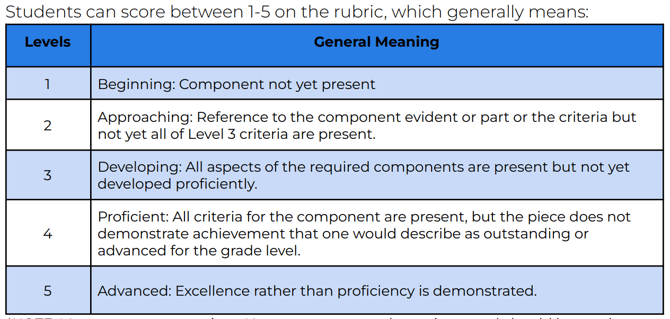
All categories are scored on a 1-5 scale with the following weights:
Claim - x3
Evidence - x5
Reasoning - x5
Coherence - x5
Audience Appeal - x2
Total Score is provided out of 100%
Shortcuts to help you provide written feedback to students faster