
Our Approach
Designed by NCTE teachers and nationally recognized literacy experts, ThinkCERCA is built upon proven methods for developing students’ language and literacy skills. The CERCA Framework is a scaffolded approach to literacy that helps students develop their critical thinking skills. ThinkCERCA’s expert-designed lessons walk students through the process of analyzing content-rich texts and multimedia, thinking about them critically, and expressing their own points of view effectively through cohesive argumentative, informational, or narrative writings.
ThinkCERCA is proven to help your students develop habits that lead to growth, as proven by studies that show 2 years of reading growth in a year and 20% growth in writing after 7-10 CERCA Slide units with feedback opportunities with teachers.
Research Base
Our program draws directly from well-established and scientifically proven methods supported by extensive research and aligns with the systematic and explicit instruction necessary for deep comprehension and retention.
ThinkCERCA’s foundational reading approach reflects the findings and recommendations of leading experts like Louisa Moats, Dan Willingham, Tim Shanahan, and E.D. Hirsch. We integrate strategies and techniques that have been rigorously tested and shown to be effective in improving reading outcomes for learners and continue to remain diligent to the evolving research findings held credible by seminal institutions such as the International Dyslexia Association, The Reading League, and the Florida Center for Reading Research.
While the support we offer for struggling readers throughout the curriculum is grounded in evidence-based practices from the predominant research in the science of reading, it is only one component of the effective reading instruction provided throughout the curriculum. ThinkCERCA’s literacy framework includes a multi-step approach to close reading and academic writing with integrated grammar, vocabulary, listening and speaking, and research activities.
A routine piece of the overall literacy framework is focused on developing evidence-based texts using the CERCA framework for critical thinking.
Curriculum Design
There is a common misconception that “the science of reading” can be packaged or is a specific pedagogy, but it is not a program that can be purchased or adopted. Effective reading instruction is based on the science of reading research and any program alignment to the science of reading may exist on a continuum.
All curricula must be implemented in connection with appropriate professional development, progress monitoring tools, and teacher understanding of developmental reading skills.
Scaffolds
Platform Scaffolds
We offer comprehensive scaffolds designed to support students throughout their learning journey. Voice-over and audio support are integrated into all lessons and texts, offering additional assistance to auditory learners. Our immersive reader feature offers translation into 60 languages through both written text and auditory support, ensuring accessibility for diverse student populations. Visual accommodations are available to aid visually impaired students or those with dyslexia.
Automated feedback provides immediate guidance to students on both writing assignments and reading comprehension exercises, promoting continuous improvement. Also available is a visual summary and corresponding lesson designed for English language learners based on the core reading passages, equipping them with the necessary language skills and background knowledge to engage effectively with upcoming texts.
Furthermore, our platform features student guides equipped with scaffolding supports such as graphic organizers and previews of units and texts, empowering students with additional resources to scaffold their learning effectively.
Unit Scaffolds
At the unit level, scaffolding plays a vital role in supporting student learning by providing various tools and features designed to enhance comprehension and engagement. Cognitive chunking is employed throughout lessons to break down complex concepts into digestible segments, aiding students in processing information effectively.
Each text strategically embeds “Pause and Reflect” questions within the content to clarify misconceptions and support metacognitive reflection.
Rubrics for writing assignments offer clear criteria for assessment, helping students understand expectations and strive for excellence.
Lesson Scaffolds
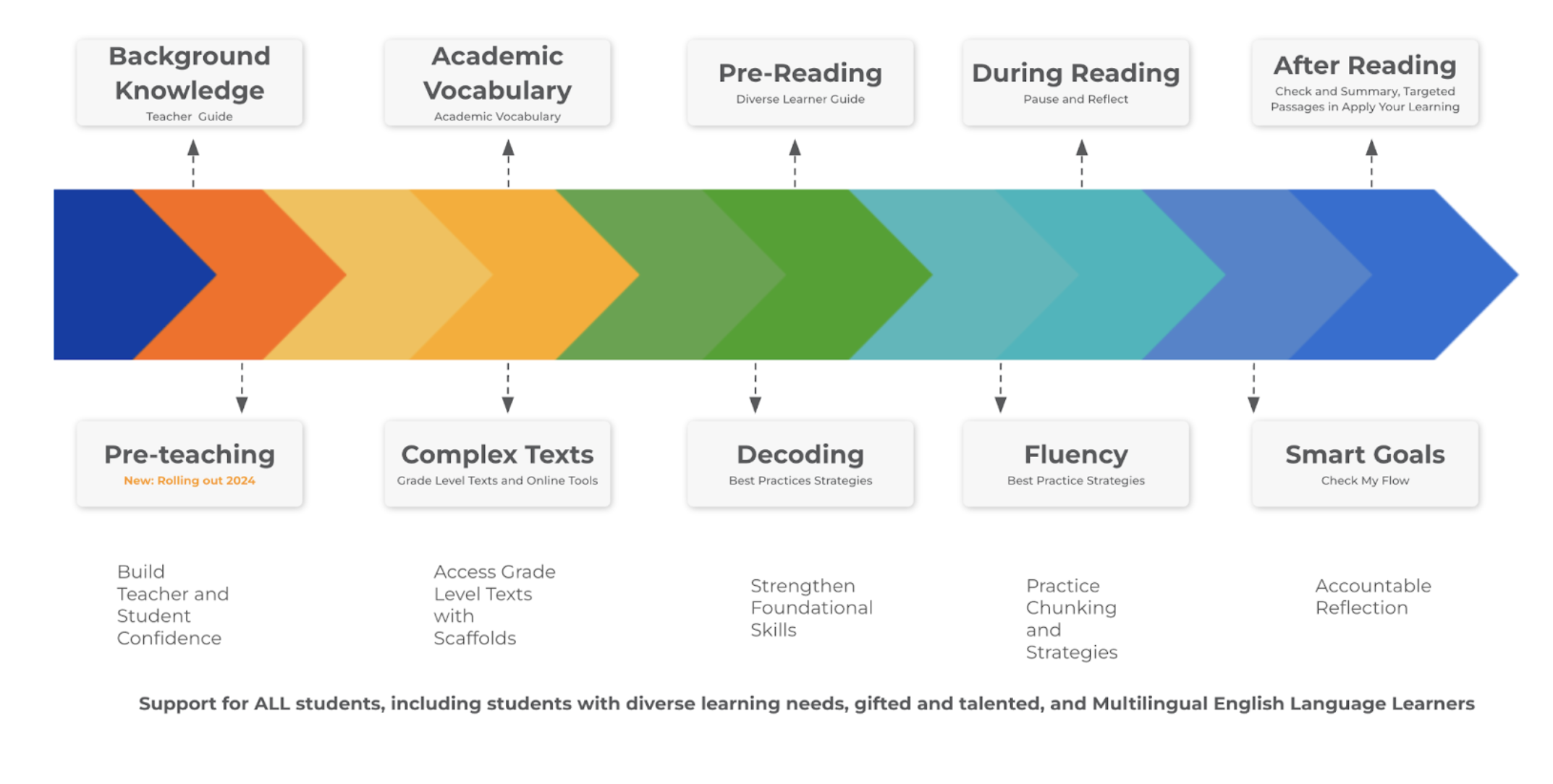
Teachers will be equipped to teach every struggling reader with the Scaffolds for Learning. Instead of teachers spending precious time combing each reading for potential barriers, we’ve done that for you in each component of teaching.
Background Knowledge provides you with essential information on each text, whether it’s historical context or tips for frontloading students with geographical references.
Key Academic Vocabulary can be a major barrier to comprehension for struggling adolescent readers. Each reading identifies a key academic vocabulary term for teachers to address before students engage with the reading. By clarifying and discussing these terms beforehand, students gain access to crucial insights they might otherwise miss. These terms encompass unfamiliar vocabulary integral to the reading or literary devices that aid in comprehending the text's structure, ensuring students are better equipped for engagement and comprehension.
Pre-Reading Strategies for each text can be found in the Diverse Learner Guides which accompany every lesson. This information supplies a quick overview of the content the students will encounter, a hook, or introductory activity to engage the class, and strategies to guide the teacher in the reading of the text.
During Reading Strategies keep students engaged by asking them to periodically “Pause and Reflect” at key moments in the text. This chunking strategy also increases engagement, clarifies misconceptions, and sharpens comprehension.
After Reading the text, students check their understanding through the “Check” and “Summarize” and “Apply Your Learning.”
Pre-teaching Lessons are designed specifically for English Language Learners and present the text in simplified language with strong visual support. This way students are scaffolded up to grade level text without having text watered down.
Decoding and Fluency are supported through Best Practice Strategies which can be applied to any level reader, whether they’re reading fiction or non-fiction text.
Goal Setting and Accountability for volume reading are established through consistent monitoring using a strategy called “Check My Flow.” This is available for any teacher or support personnel seeking to develop and encourage prolific reading habits.