
ThinkCERCA is a tool for empowerment and growth in English language proficiency.
ThinkCERCA’s connected and comprehensive curriculum is created by a multicultural and multilingual community of educators, according to the following Guiding Principles:
- English Language Learners are emerging multilingual learners whose Home Languages and diverse forms and registers of English are cherished and considered assets.
- Meaning-making and comprehension of authentic and relevant materials are paramount.
- Content serves as the anchor for foundational literacy skills development in the service of mastery of spoken and written academic language.
- An ML/ELL student’s Mastery of English expands their power and agency to exchange, create, and express ideas and participate in their community authentically.
What we offer to support grade-level access on the journey to English Language Proficiency:
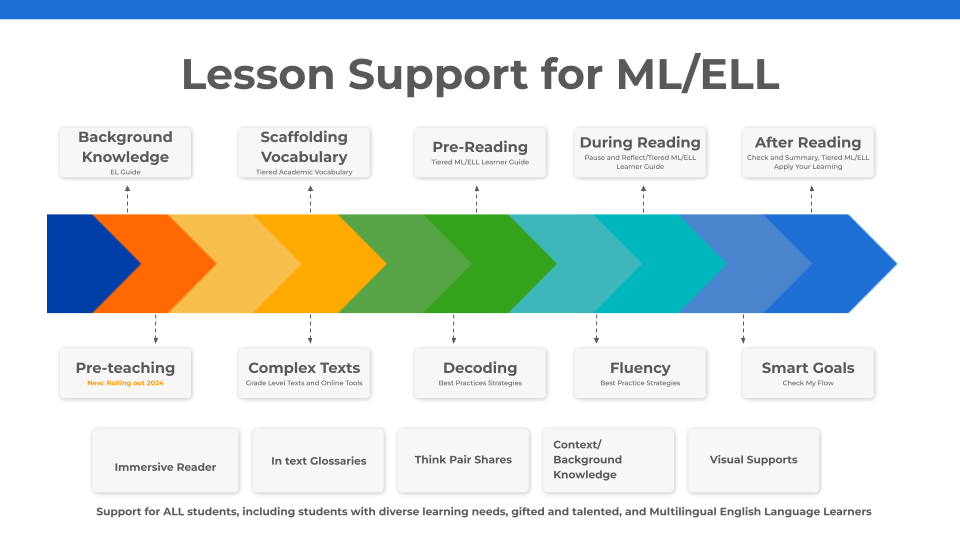
- Leveled support for language learning in the context of the Core Curriculum provides offline support to help students achieve both content and language objectives for beginning, intermediate, and advanced levels of English Learning for all grade-level anchor texts.
- Pre-teaching lessons that provide a visual summary paired with a low volume of text allow students to rehearse the critical thinking skills found in the grade-level text.
- AI-enabled reading and writing supports.
Our Approach
ThinkCERCA is built on research and best practices about how learners acquire and use language. ThinkCERCA’s focus on meaning-making promotes growth in Language-based Skills and Code-based Skills in literacy development and promotes the coexisting development of multiple language systems.
ThinkCERCA prioritizes providing interesting, rigorous, authentic texts combined with scaffolds and tools that empower all learners to participate fully in communities of learning and belonging. Read-aloud and Immersive Reader empower learners to understand the relationship between graphemes and phonemes in a connected and comprehensive way. (Fillmore (2017) and Scarcella (2003)).
ThinkCERCA intentionally develops semantic knowledge, expressive and receptive vocabulary, syntactic knowledge , word order, and grammatical rules, and narrative discourse skills, along with morphosyntactic development, modeling the use of multi-word lexical items through rich comprehensible input.
ThinkCERCA uses evidence-based English Development strategies, delivering critical thinking and reasoning for all learners. ThinkCERCA empowers learners to access new information and express their own thoughts. ThinkCERCA leverages existing online and print resources that promote Metalinguistic awareness, harnessing home language and vernacular. Additionally, at ThinkCERCA, we know emergent bilinguals' identities are assets to their academic journeys and include culturally relevant texts in order to enhance students’ cultural schema.
Our Design
- Integrated content and language learning objectives
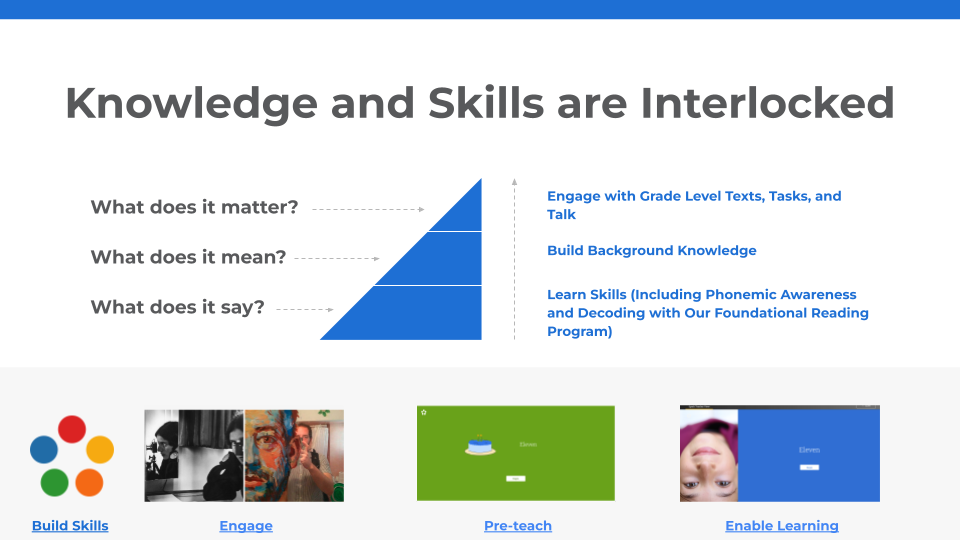
- Background knowledge-building resources to front-load language and content (pre-teach content and vocabulary)
- Opportunities to provide comprehensible Input and build schemas
- Culturally relevant texts reflecting diverse representations of cultural groups
- Contextualized literacy skills development
- Scaffolding
- Opportunities to leverage students’ native language as a foundational resource
- Asset-based approaches to pedagogy (all learners have language and co-construct meaning through interactions with text, thought, teacher, self, and peers)
- AI-enabled tools such as Immersive Reader with image support and differentiated materials promote learner autonomy for students from all language backgrounds.
- ELL-focused strategies can be useful for ALL students
Tier 1 Support for Grade-Level Access for Emerging Multilingual and Diverse Learners
- See ThinkCERCA’s Alignment to WIDA
- Online support
- Pre-teaching lessons: To fill background knowledge gaps and rehearse skills
- Text Customization: Adjust color, size, spacing
- Syllable Splitting: For fluency practice/deeper analysis
- Parts of Speech: For deeper analysis
- Picture Dictionary → Visual representation of words
- Line Focus → To reduce distraction
- Text-to-Speech → Adjustable voices for read-aloud
- Adjustable Reading Speed → To slow down or speed up read aloud
- Real-time Translation → Read in 165 languages and leverage bilingual read-aloud in more than 50 languages
- Speech-to-Text: To enable drafting and revision by voice in multiple languages
- Automated Feedback and Scoring: For nurturing and actionable revision guidance, progress monitoring, and support for goal-setting
3 Grade Level Access Points: Student Guides to Support Beginning, Intermediate, and Advanced English Learners
The English Language Learner Student Guide contains templates and graphic organizers that can be used to support diverse learners. These tools are based on templates from the standard grade level student guide, but offer more options for:
- Graphic organizers are designed to help students organize thoughts and ideas
- Better visual accessibility
- Simplifying and clarifying directives
- Distinct task chunking
- Reduced conceptual complexity
- Modified rubrics to assess components of writing
- Examples and sentence starters to scaffold writing
- Scaffolds to move from maximal to minimal scaffolding
Foundational Reading and Linguistics for Secondary English Learners
For students who are learning English while simultaneously developing foundational reading skills, learn more about our 6-12 Foundational Reading and Linguistics Course here.
Our Research-Based Instructional Design
Effective language and literacy development for all learners, including English Language Learners, should place “a greater emphasis on language and literacy across content instruction, representing a shift toward using more informational (nonfiction) text, with a focus on argumentation.
Research on second language acquisition calls for emphasizing language and literacy in the content area classroom. Effective second language instruction focuses on context-embedded instruction and authentic task-based practices (Lightbown & Spada, 2006), so ThinkCERCA prides itself on being a liberatory tool for building English Language Proficiency.
According to the Center for Applied Linguistics (CAL)’s Practitioner Brief on Implementing Common Core for English Learners - Responses to Common Questions:
“Language learners also need authentic opportunities to interact in the target language and with native speakers of the target language (Light-brown & Spada, 2006). Teachers need to require and scaffold academic language use, giving students authentic reasons to communicate and the skills to apply their academic language to contexts beyond the classroom. Academic language is defined broadly as the cross-curricular and discipline-specific language needed to be successful in school, including vocabulary, morphology, grammatical structures, turn-taking in conversations, and more (Anstrom et. al., 2010).”
The ThinkCERCA model provides these essential elements for English Language development:
- Relevant, authentic, and highly interesting texts
- Glosses and visual support for lexical access and development
- Context and purpose for communicating using the target language
- Sentence starters and schema for organizing and structuring thought and speech
- The ThinkCERCA framework for making claims, finding evidence, reasoning, counterclaims, and arguments.
- Practice in all four modes of communication: Listening, Speaking, Reading, and Writing, in formal and informal registers.
The ThinkCERCA platform empowers all learners to use argumentation as the signature practice that makes language learning a meaning-rich, authentic, and profoundly humanizing experience for monolingual and emerging bilingual students alike.
“English learners who have grade-level decoding skills may not understand what they read if they are not familiar with the vocabulary or grammatical structures, or have limited experiences with the content of the text. All students need literacy instruction that attends to meaning first, including explicit development of vocabulary” (Graves, August, & Mancilla-Martinez, 2013)
Accordingly, CERCASlides are accompanied by read-aloud, lesson-specific glossaries, and CERCASounds to support learners in decoding the spelling and sounds of English, as well as ThinkVOCABULARY to help learners understand vocabulary and unlock meaning.
ThinkCERCA’s extensive lesson library allows learners to “level up” or find additional phonemic and lexical support either by accessing more complex texts or by accessing the ThinkVOCABULARY and CERCASounds lessons.
AI-Enabled Scaffolding Access to Grade-Level Texts for All Students
ThinkCERCA believes in scaffolding to support all students in understanding grade-level texts rather than simplifying texts in Tier I courses. Through our support for reading accessibility, cognitive chunking, and reading enablement tools like Immersive Reader, we assist students who are approaching grade level. We also support frontloading background knowledge with more accessible Tier II texts and skills instruction, which are coherently aligned to Tier 1. With high expectations for all students and scaffolding to support access and growth, students can achieve more.
Beyond comprehension, our approach assists students in developing textual power (Scholes, 2011). Textual analysis and critical thinking skills progressions allow students to apply an ever-increasing level of sophistication in their reading and writing practices.
Through the scaffolding described in the coming pages and the accessibility tools enabled on our platform, including support for frontloading and co-teaching, we offer many onramps to grade level. In each, we consider qualitative and quantitative complexity, as well as the reader and the task.
Within our Tier 2 intervention resources, the whole team can assist in finding resources to support the full MTSS process.
Center for Applied Linguistics (CAL)’s Practitioner Brief on Implementing Common Core for English Learners - Responses to Common Questions
Krashen, S. D., & Terrell, T. D. (1983). The natural approach: Language acquisition in the classroom. New York: Pergamon Press
3 Ways to Prioritize Multilingual Learners in Your Curriculum Adoption Process - Margaret Overbagh-Feld